

When the path disappears: The quiet power of awe
Why the most meaningful paths in life are rarely straight

Dear Friends,
Have you ever found yourself lost, not just geographically but in life, only to realize later that the detour held an important lesson? This week’s reflection explores a moment like that for me on a mountain in East Africa.

Perfectionism wants a straight line.
It wants the map, the plan, the predictable route from effort to outcome.
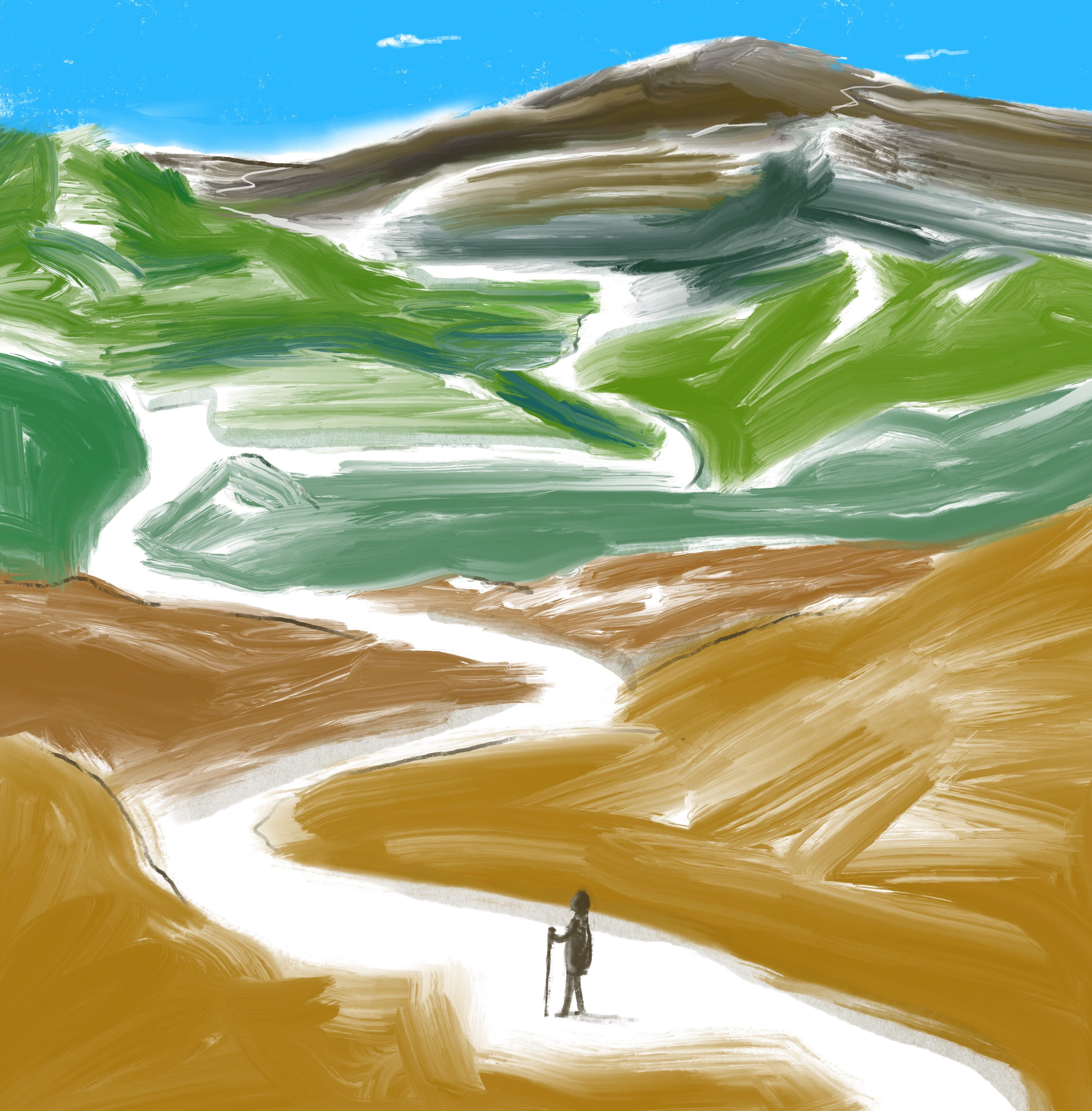
But life rarely works that way. The most meaningful experiences often arrive when the path disappears, when we’re forced to slow down, look up, and trust something other than control.
Awe has a way of doing that. It interrupts the mind’s narrow focus and reminds us that we are part of something larger.
I learned this lesson unexpectedly many years ago on a mountain in East Africa.
The day I got lost
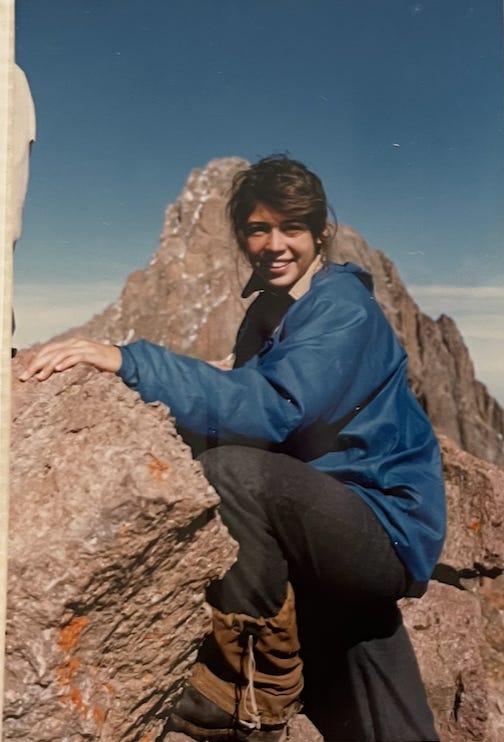
When I was twenty years old and in crisis, I climbed Mt. Kenya with a group of wayward young adults in an outdoor leadership program. I had saved for the trip by waiting tables and cleaning motel rooms one summer. Essentially, I needed to get as far away from home as possible, and Africa seemed like a good enough distance.
The head guides, a young married couple, gave us some basic instructions and reprimanded those of us who tried to sneak toilet paper into our backpacks. We hiked up slowly to acclimate and quickly learned who the complainers were in the group.
Once we reached the top, we were randomly divided into teams for the first venture back down to basecamp. Each team voted on a leader. Anyone with camping experience?
It turned out I was on the losing team.
We got very lost.
We didn’t follow the map. Our new hiking boots produced boiling blisters. Our bodies ached. We froze at night and overheated during the day. Over the course of several days we fought, cried, and laughed.
At one point we were chased by a baby elephant. Still a very large creature. I peed in my pants. Our clunky backpacks tangled in bamboo forests as we crawled on hands and knees, only to emerge suddenly at the edge of a ravine of sublime beauty.
It was painful and exhilarating all at once. The landscape felt like some secret place on earth that had been waiting quietly for us to stumble into it. I remember thinking that I was a mere creature in this vast, living world.
It was the first time I understood the true meaning of awe.
Awe (noun): an overwhelming feeling of reverence, admiration, or wonder produced by something grand, sublime, or powerful.
The other two teams had quickly found the straight dirt path and returned to basecamp in half a day. They never saw the ravines, the animals, the luminous flowers, the bamboo thickets, or the shifting patterns of fragrance and dappled light.
Getting lost turned out to be the gift.
It remains one of the most formative and spiritual experiences of my life.
There are no straight lines if you want to grow your soul.
Of course, it helps to have guides and a few basic tools. But more often than not, the wisest guide is already inside you.
What awe reveals
Looking back, what stayed with me most was not the fear of being lost. It was the sudden shift in perspective.
When the usual plan dissolves, something else can emerge: curiosity, humility, even wonder.
Psychologists describe awe as the emotion that arises when we encounter something vast that challenges our usual way of understanding the world. In moments of awe, our attention widens. We stop obsessing about our small worries and begin to see ourselves within a much larger landscape.
For people who tend toward perfectionism, this shift can be especially powerful.
Perfectionism narrows the mind. It whispers that every step must be correct, every outcome controlled, every effort proof of your worth.
Awe does the opposite. It expands the frame. Suddenly the path doesn’t have to be perfect. You simply need to take a next step.
Moments of awe, whether found in nature, music, art, or quiet reflection, soften the grip of the inner critic. They remind us that growth rarely happens along straight lines.
I have found that some of most important self-discoveries happen when we wander.
A small insight
Awe interrupts the inner critic.
You may be familiar with your Plus One, the part of you that is alway at your side telling you what you should or shouldn’t do. It may be an inner judge, bully, nitpicker, sleuth or joy thief. It could be a whole crew.
Yet, when the horizon expands, the critical voice often shrinks. Your Plus One is silenced. The ego disappears. And you remember that you are part of a much bigger story than the one running in your head. From that wider view, courage to make a change becomes a little easier.
Awe does something powerful to the mind. It widens perspective.
Blessedly, we can do this in every day life. You don’t even have to go very far. To prime this shift, you might try a simple three-minute “Awe Reset.”
Pause and lift your gaze. If you can, step outside and look toward the sky, trees, or a distant horizon. Even a photograph of a vast landscape can work.
Take a few slow breaths and imagine your awareness widening beyond the immediate problem you’re holding. Let your attention take in the larger environment around you. Zoom out.
Then gently ask yourself a quiet question: What might change if I approached this situation with curiosity rather than control? Is there another way to look at this.
You don’t need to rush toward an answer. Often the shift in perspective is enough. Sometimes I think to put myself back in that naive 20 year old’s mind and see things in a whole new way. It may mean just stepping out and sitting on a bench, listening to the birds and recognizing just how fleeting this moment really is.
The capacity for awe is always nearby.
If this reflection resonates, you might want to explore it more personally. For paid subscribers, I’ve created a Crooked Path Reflection worksheet with prompts to help you map your own crooked path.
